Tuesday, 27 May 2014

International Premium Cigar & Pipe Retailer Show at Las Vegas 2014

The International Premium Cigar & Pipe Retailers 82nd Annual Convention & International Trade Show (IPCPR) kicks off on July 19 in Las Vegas. It’s the industry’s largest event, with last year’s show drawing over 6,000 manufacturers, retailers and media members, and this year is promising to be even bigger.
It will be an exciting event where the Cigar's World will meet in one large smoking room. World famous cigar maker will be there with their whole range, past and future.
I will be there to meet & great the giants from the industry and most important, to source and taste new brands to bring back at The Wall of Cigar for our patrons to discover and try !

OFFICIAL WEBSITE

Defects found in a Cigar - Part II

To read part one click HERE

(Based on the book of Didier Houvenaghel " From Soil to Soul")

3) Defects to the touch


Cigar too dry or too moist


A balanced level of humidity is needed for the cigar to yield fully all of its aromatic potential.
If too dry, it will probably have a dusty taste. if the cigar is kept too long in dry environment, it will cause irreversible diminution of the aromas due to evaporation of the essential oils and waxes.
If too moist, it will certainly be more aggressive as during combustion it will produce irritant compounds.
If you feel that the wrapper is overly moist, it will surely burn slower than the binder and the filler resulting in tunneling and diminish the enjoyment of the smoke

Tight or loose cigar

A cigar is too tight or too loose when the constituent leaves have been packed too densely or not enough. These will affect the draw.

Irregularity of the torcido

This defect in the rolling causes disparities in the diameter and/or in the density of different sections in the length of the cigar.
The combustion and draw of the cigar are usually adversely affected

Bunch line

A real ridge running the whole length of the cigar, this line is caused by having too much raw material in the bunch, by a badly handled pressing or by a defective or imprecise press.
In the first case the draw will be too hard. On the two other cases, the defect will be visual and the enjoyment will be scarcely affected.

Azocado Tobacco

The cigar is significantly harder at one end. Two reasons :
- Rolling error with the use of a larger binder leaf than the standard use for the model rolled.
- The possible presence of too much matter at the hard end

Hard Cigar

The hardness of the cigar can be the result of an excessive humidity level in the filler at the time of rolling or of defective maturity of the leaves. In this case, the leaves dry out after being rolled and this causes hardening.

Bad Symmetry in the head

This is a result either of a defective press or of an error in the torcido, caused by a bad cutting out of the head, which was incorrectly positioned when the cigar was being finished off, and/or was handicapped by the presence of too heavy veining.


4) Defects to the nose & the ear


Lack of aromas

The defect of a cigar made up of leaves with deficient chemical constitution, particularly lacking oils, waxes & resins. The absence of all or part of these aromatic components of the leaves can be caused by :
   - the variety of plant used
   - the poor quality of the soil
   - excessive exposure to strong sunlight
   - inadequate drying
   - unduly prolonged or too hot fermentation
If the cigar possesses satifactory aromas when it is rolled but loses them later on, the likely causes are :
- inappropriate storage conditions, particularly an excessively dry atmosphere
- contact with a material whose aroma wipe out those of the cigar

Dusty smell

This odor is emitted by leaves which have undergone intense fermentation, either too rapid or too strong

Ammonia smell

Some of the leaves may have not been enough fermented, so the leaves have a higher than usual concentration of irritant substances.
if the smell is too strong in a box of cigars, it means it has to be discarded. This odor in a box is usually the sign that the fermentation was halted prematurely. The cigars had therefore no time to rid themselves of their excess moisture and to eliminate the traces of ammonia from the fermentation.

Smell of wood

Cigars which have been too much in contact with too highly scented wood will have their aromas obliterated by those of the wood.

The sound

Excessive or nonexistent crackling respectively indicate that the wrapper is too dry or too moist.

 5) Defects in the cut


The cut


It should be clean to ensure that the foot is perfectly flat. A badly execute cut can cause the wrapper to unravel. Similarly, cutting a cigar which is too dry may cause the wrapper to come undone.

The first mouth

During the raw tasting, by which the cigar lover gets his first impression of the internal aromas of the cigar, he may perceive some unpleasant odors, the most frequent ones being dusty or slightly sharp. The complex bundle of aromas may also be unbalanced.
The presence of these unwanted smells is unfortunately confirmed most of the time only when the cigar is lit.

 5) Defects in the lighting up


 Irregular lighting

A cigar which is not evenly lit will suffer from unbalanced initial combustion. This defect may rectify itself as the combustion zone progresses, but in some cases it causes major problems and obliges the smoker to intervene to sort out this bad start.
This irregular lighting can be of two kinds :
   - partial lighting of the cross-section of the cigar, some leaves take and others remain unlit, resulting in a crooked combustion zone
   - filler leaves burning too intensely in relation to the binder and wrapper. The combustion being better and more quickly establishe in the centre, will makes an hollow cone.
However some combustion defects when perfectly lit,  may be cause by insufficient combustible leaves or excessive humidity.

6) Defects in the taste

 Unpleasant Flavor

Unbalanced and unpleasant gustatory and retro-olfactory perception caused by
  • badly conceived blend with errors such as the use of unsuitable variety of tobacco
  • an ideal blend not correctly followed by the roller
  • an ideal blend but which includes one or more leaves suffering from aromatic defect 
 
Too high Fortaleza

The fortaleza, or strength, is the consequence of the type of raw material chosen. Leaves from the upper part of the plant, being therefore thicker and richer than those at the base of the stem, will produce a stronger blend.
When too many leaves from the upper part are used, the cigar will be so powerful that the aromatic complexity will be overwhelmed.

Sharpness in the mouth

This sensation, which is often the result of a lack of fermentation of some of the leaves in the blend, is due to excessive levels of irritant substances. The sting is felt on the tip of the tongue at the moment the smoke enters the mouth

Stinging on the lips

A disagreeable sensation caused by insufficient fermentation of the wrapper. The irritant substances, which have not been properly eliminated by process, make themselves felt as soon as the lips get in contact with wrapper.

Slight acidity

Effects caused by a nutritional imbalance of plants rooted in soil having too high levels of magnesium, sulphur and copper.

Bitterness

This unpleasant sensation, which makes itself felt at the rear of the oral cavity at the entrance of the throat, is usually caused by the presence of a too large quantity of proteins, owing to incorrectly handled drying and fermentation.
This problem is encountered rather too frequently.

Poor aromatic profile

The cigar is boring and monotonous. The savor should be progressively transformed as the combustion goes. In some cases, this progression should be astonishing, while in others it is less marked. If it is non-existent, the cigar is flat and the reasons can be : empty, characterless tobacco, bad blending or incorrect positioning of the  finishing leaves.


7) Defects in the combustion


Bad draw

Too great or too little resistance to the passage of air during a puff can be the result of any of several errors, but the most common is using too much or not enough raw material when making the bunch.
A hard draw can also be due to the presence of a knot caused by a bad positioning of the filler leaves or the fact that these were by mistake twisted when the binder was wrapped around them.

Heat in the body of cigar during a puff

This calorific diffusion is due to a high degree of humidity in the cigar facilitating the conduction of heat. The unusual high temperature can sometimes be felt in the fingers. The excessive moisture content will affect the quality of the combustion.

Disparate combustion ring


This unevenness is caused by the combustion on one side of the cigar being ahead of that on the other side because.
  • the cigar was lit unevenly,
  • the torcido is unevenly constructed, as the cigar was badly rolled, the density is not homogeneous
  • the presence of a thick vein is slowing down the combustion
  • there is too much moisture in certain leaves of the cigar
  • a strong draught over the cigar is distorting combustion
However it is rare for a combustion ring to remain perfect all along the body of the cigar.
There is two way to correct it, to turn the slowest burning side up, the heat will accelerate the combustion and help to catch up or to use a lighter to re-light the slow burning part.

Cigar goes out

A problem in the combustibility can result in the cigar going out at regular interval. Reasons are :
  • excessive quantities of proteins or chlorine in the chemistry of the leaves
  • too high humidity in the leaves, above 15% of constituent humidity
  • a too tight packed cigar with very restricted air flow

Tunneling


A cigar will have a crater type of shape when the leaves in the center burn quicker than those on the outside. The probable reasons are :
leaves have a poor combustibility
wrapper and binder leaves are a wrong porosity
a badly conceived blend of leaves
mediocre construction of the cigar
improper lighting of the cigar
a difference in the humidity levels of the wrapper, binder and filler leaves.
As the temperature is higher in the center of the cigar, the combustion is always easier along the axis of the cylinder.

Black ash


If the chemical composition of the leaves is inadequate, there will be incomplete combustion of the organic matter and the cigar will have trace of an unpleasant taste. An excessive quantity of carbon in the residue of this combustion will make ash black.

Ash falling easily from cigar

This defect is sometimes caused by a bad tecture of the leaves, but it is more often the result of a the leaves that were badly put together in the bunch.


(The end...)


Wednesday, 14 May 2014

How to prepare your humidor after purchase

When you buy a humidor, it is not "ready to use". Too many humidors come with the minimum which is a Hygrometer & a Humidifier, but Adorini Humidors come with more than that.
Distilled Water with added ions is supplied and also  an User Manual to explain you how a Humidor is made, the basic on how to preserve your cigars and also how to prepare your humidor after purchase.


The Little" Grand" Story of Opus X


We offer at the Wall of Cigar a good range of 14 references from Arturo Fuente.

The Fuente Story

At 24 years old, young Cuban immigrant, Arturo Fuente established his name with the launch of self-named brand of cigar in Tampa, Florida.
However in 1924, his dream was destroyed by a fire. Hope was lost and his 500 workers lost their job.

Restored 1903 Fuente Factory in West Tampa, Florida

Little is known on what happened after, but the brand re-emerged in 1946 with a limited production made by himself and his family and few friends who joined. From a large production, it became 22 years later a Family Affair with only a few thousands cigars a year.
The son of Arturo, Carlos Fuente took over in 1958 after buying the company from his father for $1.
In 1962, the US Embargo cut the supply of Cuban Tobacco and Carlos had to find new source of tobacco, from Porto Rico to Colombia or even Mexico.
In 1970, the booming of the Nicaraguan cigar industry facilitate the opening of a brand new Fuente factory in Esteli, Nicaragua.
But in 1979, during the Nicaraguan revolution, the tragedy striked again the Fuente Family and the factory was once again burnt to the ground.
However, Carlos moved to Dominican republic shortly after and could open a new factory in 1980, Chateau Fuente.
Carlos created and launched a new cigar called Hemingway which was a revolution in the world of cigar with its special shape.


His son Carlos Jr., known under Carlito (Little Carlos) joined him in the operation.
As per today, Father and Son oversee a production of 30 Million Cigars a year.


The Opus X Story

“I wanted to prove that I deserve to exist in the Fuente family,”
Such strong words behind the motivation to create one of the "Great Cigar" of our time.

Carlito has never been happy in just continuing the family legacy, he wanted to revolution it.
Instead to look forward in looked at the cigars of the past,  he wanted to re-introduced the forgotten cigars from Cuba, those full-flavored bold cigars that Aficionados loved so much.
During his youth, Carlito learned the business in Dominican Republic in a factory owned by a Cuban Family. It is there that he discovered bold Cuban cigars.
He was certain that the tobacco  from Chateau Fuente could match the bold Cuban tobacco
The Profession thought that Carlito was crazy and would ruined the Fuente family reputation as his project would failed and the loss of money would be so big that it would destroyed the legacy.
For 4 years he tried many blends to finally find the perfect blend made with 5 distinct tobacco.
He then created a very elastic and oily wrapper, a Dominican grown wrapper, which had a reddish brown color.


Now that the blend was ready, who could roll this new cigar but being positive in the success of it and who would roll it the exact way Carlito wanted?
Carlito did what no one would have dare to do, he recruited youngsters between 18 & 21 years old without any experiences in rolling. During months he taught them how to roll the Carlito's way but he taught them also Cuban Culture, he made them listening Cuban Music, he read them Cuban Literature. he wanted them to understand Cuba so they could understand how to roll a Cuban style cigar the Cuban way.  The average cigar production per roller is 200 cigars per day but those rolling the New Cigar only rolled 50-75 a day.
Then the name had to be chosen. Opus is the Latin translation of the Spanish word obra, which means work of art, and the X is what was left from the original name which was Project X.
For the design he inspire himself from lithography from the 19th century.

When it was released in 1995, perhaps no single cigar has ever been as universally hailed as the Fuente Fuente Opus X.


Cigar Aficionado magazine nicknamed it “Seeds of Hope” and gave the cigar the highest rating any new cigar had ever received–92 out of 100.
Tobacco International magazine named Carlos and Carlito the “Tobacco People of the Year.”
The greatest praise the Fuente Fuente Opus X received, however, was when their competitors began producing cigars with the bold flavoring of years past as well.
Carlito revolutionized the cigar industry, just as he set out to do.
 As per today Cigar Aficionado branded Opus X as "the most sought-after cigars in the world".

It is said that the Opus X is extremely rare and difficult to find but at The Wall of Cigar you will find some of them. such as the Belicoso XXX, the Perfecxion X, the Robusto and soon the Reserva D'Chateau.

Not only a great cigar but also visually stunning.

Download our Arturo Fuente Price List Here

In 2012, Arturo Fuente celebrated 100 years of History !


The Fuente Story Video


The Fuente Family : An American Dream Documentary by James Orr


Saturday, 10 May 2014

What are the options to revive a dried out cigar?

It happens to everyone to forget a good cigar and that it dried out, or a box or even the whole humidor.
Cigars need attention but sometimes our busy life make us concentrate on something else and let us forget about life's pleasure.
Do not worry if the wrapper didn't crack then the cigars are not ruined, but yes, their quality aromatic decreased.

When a cigar drying out, the oils contained in the leaves that makes the cigar so aromatic are evaporating and the moisture will go with it. Once the oils are gone, the aromas are reduced or sometimes will totally disappear.

There are few methods to revive a cigar but every methods will need patience and time.

1) The Tupperware Method :

Take a plastic container big enough (cigars need to occupy not more than 25% of the space) and put inside your dried cigars and a hygrometer. make sure you can read the hygrometer without opening the box. Seal the container and wait a few hours to read the hygrometer. So it already gives you an idea at which Relative Humidity (RH) you start.
Take a humidifier device and add a very small quantity of water and seal the container again. Wait for a while and check again. the RH should have raise a bit.
Add water once everyday until you reach a RH of 70%. It can take a week, sometimes more.
Once you reached 70%, make sure to maintain this level. Do not go back lower than 65% or higher than 75%.
After couple of weeks at 70%, the cigars should be ready to be transferred back in your humidor.
Please note that you will need to wait at least a month, maybe more before you can smoke it because the humidity needs to stabilize thru the different layers in the cigar. Some people say that you need to wait 6 to 12 months before you can smoke them, but i do think it depends on how dry the cigars were before reviving them.
Make sure to keep the container away from the light and the heat.

2) The Zip-Lock Bag Method:

Take your box of dried cigars, open it and put it in a large zip-lock bag. Make sure that you have small holes made in advance in the zip-lock. Then put the bag in a larger zip-lock bag.
Before you air-tight seal the larger bag, put inside a slightly damp towels, sponge or humidifier device.
You will have to give a quarter of turn to the cigars in the box, once every two days. You also need to make sure that the towel/sponge/humidifier is always slightly humid. After 2-3 weeks, you can put back the cigars in your humidor. Wait few weeks before smoking them.

3) The Damp Towel Method:

If the cigars are not too dried, just roll a damp towel around the cigar box for two weeks. Make sure the towel is not wet as you do not want the water to be absorbed by the cedar box.

4) The Sauna Method :

It is winter and when you take your shower the bathroom feel like a sauna? Then use the humid environment to revive your cigars.
Every time you take a shower, open your box of cigars (if cigars are very dried, leave the box closed), then after your shower close the box, it will trap the moisture inside. Rotate the cigars every couple of days. After two to three weeks left in the bathroom, you may put back the cigars in your humidor.

5) The Classic Method.

Take an empty humidor that didn't contain cigars for a while and put your dried cigars in it. let them there for few days. Then add a humidifier device that you fill up partially. Let at rest for one week.
You can then fill up fully the humidifier and wait one more week.


NOTES :

- The humidity in the cigars has to be restored slowly as if too quick, the wrapper will split.
- It is a better option to do not store your Cubans cigars with non-Cubans cigars.
- During the process 1 & 5, make sure to do not charge the box/humidor more than 25%


Do not forget, The Wall of Cigar offer Storage option with our Private Lockers.

CLICK HERE TO CHECK OUT OUR LOCKERS RENTAL FEES 


Friday, 9 May 2014

Defects found in a cigar - Part I

When going around Cigar reviews on magazines or websites i can often read with much details why reviewers loved the cigar but their negative reviews are never explained as much with details as their good ones.
It is the same with cigar smokers, they usually can describe why they like it but not much why they do not like it.
It can be indeed a question of personal taste but it can also be due to a defect on the cigar they just smoked.

I knew myself a few defects and how to explain them but after reading a very good book relating the traditional " seed to smoke" story but seen by the eyes of an agricultural engineer, i got a more detailed and scientific approach to the subject.

This book was written by Didier Houvenaghel in 2006 and is called " From Soil to Soul" (English version). If you are really into cigar knowledge, i definitely recommend the read.

Defects are numerous and have different origins. Let's go thru every single of them.

1) Storage Issue
  • The humidity conditions of the storage are not met
    • Too moist, some mold will develop and will affect the outlook and the taste of the cigar 

    • Too dry will caused the evaporation of the water contained in the leaves but also the disappearance of the oils and resins which will be decrease the aromatic quality of the leaves and leave a dusty taste.

  • The ventilation conditions of the storage are not met
    • Too little will increase the risk of moldy environment
    • Too much will increase the risk of dryness of the cigars
  • Storage in an over-lighten environment
    • Too much direct light will affect the quality of the wrappers, fading their color and reducing aromas.
    • Too much direct light will dry the cigars
  • Rough storage
    • If the cigars are not properly stored the wrapper may be teared or the foot may be split


2) The sight (wrapper)

  • Green Wrapper

    • The wrapper lacked technical maturity during harvest
    • The drying has been speed up by increasing temperature
    • Such wrapper does not have aromatic qualities having a higher concentration of substances such as chlorophyll pigment.
    • However during a certain period green wrapper were deliberately created for the U.S market as some cigar lovers enjoyed such characteristic. It is called "Candelas"

  • Dark to Black Wrapper
        When unwanted, this unusual color is due to various factors :
    • The type of soil
    • The wrapper being too thick and too oily, darkens during the various treatment
    • The fermentation was too long
    • Wrappers from some types of tobacco plant are more sensitive and will darken more easily

  • Lack of glossiness
         It is due to the insufficiency of oils due to:
    • Unsuitable soils
    • Unfavorable climatic conditions during the growth of the plant
    • The harvest was done when the leaves were too mature
    • Not enough water in the leaves when harvested 
    • Excessive temperatures during drying and fermentation
    • Storage in too dry condition causing a evaporation of the oils

  • Green spots
        It is some patches of chlorophyll pigments that remained after treatments, which were caused by
    • Faulty drying : high temperatures caused a rapid loss of water leading to the quick precipitation of the pigments
    • Small damaged done to the leaves which increased the concentration of chlorophyll around it
    • Presence of chlorophyll will decrease the aromatic quality of the cigar.


  • Dark green spots
    • High level of humidity during the drying due to water saturation in the leaf. The concentration of those dark green patches in a part of the cigar is called "snakeskin"

  • Yellow spots
    • Lack of humidity during drying process resulting in this yellowish pigment

  • Black spots

    • Result of a very high humidity during drying, preventing the elimination of the sugars and starch content in the leaf, the patches will turn black during fermentation
    •  The cigar will have an unpleasant and irritant taste due to the concentration of the sugars and starch

  • White spots
         Visually unpleasant, but not affecting the quality of the cigar. it is caused by :
    • Result of a fungus disease called "Cercospora" that appear on mature leaves, which reduce the quantity of chlorophyll before the leaves are harvested.
    • Larger spots are result of another fungus disease called "Moho Azul" that appear on green leaves around the veins

  • White or black veins
         These defects can be caused by :
    • Environmental disease
    • Nutritional deficiency resulting from poor soil or insufficient fertilization
    • Fluctuations of humidity and/or of temperature during drying process

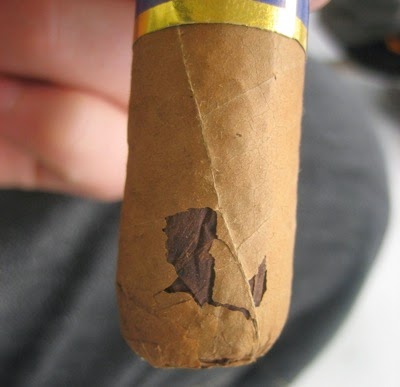
  • Tears
         Damage caused by knocks during handling of the finished cigar.
         A dry cigar will be easier to damage

  • Loose wrapper
    • The wrapper hasn't been properly stretched to the bunch.
    • Not enough elasticity in the wrapper used
    • A twisted vein exerting a physical stress

  • Irregular cut of the foot
         The problem is due to :
    • Badly sharpened guillotine used after the rolling
    • Hesitant movement from the roller
    • The leaves used were too dry and even with a sharp guillotine it will caused some splits in the wrapper.

  • Turns of the wrapper along the cigar
          The wrapper should be rolled around the bunch in two or three turns and the overlap should                 be limited to three with regular spacing.
          Beyond that it is evident that the cigar will be badly rolled or that the wrapper used
          was too small or thin for the bunch.
          However for longer cigars will require more overlaps

  • Holes due to Lasioderma Serricorne L.
    • The larvae of this beetle, in the form of small worms, feed on tobacco leaves, wheteher rolled or loose, and they leave large numbers of holes.
    • When they attack a cigar, the larvae bore galleries which upset the combustion by modifying the flow of air to such extend that the cigar is ruined.

  • White Mycelium on the internal leaves of the cigar
       This deposit, showing as a kind of white veil spread over the surface of the leaves of the blend,
        is the fruit of an attack of the Moho which develops during the fermentation phase.
       This Moho ( unlike the Moho Azul) gives an unpleasant and characteristic smell to the cigar.


(TO BE CONTINUED......)

Thursday, 8 May 2014

Featured : Adorini Cigar Cutters - Finest German Quality


Since early April The Wall of Cigar offers in exclusivity at its Macau Boutique the Brand of Accessories Adorini, Famous for its high quality humidors but Adorini also produce a good range of smaller accessories such as lighters, cutters, cigar cases, humidifier system...

Adorini makes 3 Cigar Cutters made with German Solingen Blades which are the highest German Quality available.

Solingen is a city in North Rhine-Westphalia, Germany. It is located on the northern edge of the region called Bergisches Land, south of the Ruhr area, and with a 2009 population of 161,366 is the second largest city in the Bergisches Land. It is a member of the regional authority of the Rhineland.
Solingen is called the "City of Blades", since it has long been renowned for the manufacturing of fine swords, knives, scissors and razors made by famous firms.
Solingen earned a reputation for producing some of the best blades n the world. 


Adorini Neptune Cutter Chrome with Solingen Blades

The blades of this cutter are made of highest grade steel also used for chirurgical knives and have been polished by hand by an experienced grinder in Solingen.
Blades hardened to 57 Rockwell (Stronger than regular steel)
Fits cigars of ring gauge up to 52.   

Retail : HKD 990


Adorini Neptune Cutter Black lacquered & Stainless Steel with Solingen Blades

The blades of this cutter are made of highest grade steel also used for chirurgical knives and have been polished by hand by an experienced grinder in Solingen.
Blades hardened to 57 Rockwell (Stronger than regular steel)
Fits cigars of ring gauge up to 52.   

Retail : HKD 990


 Adorini Neptune Cutter Black with  Ceramic Solingen Blades

This is the top model of the Adorini cutters with blades "Made in Solingen" additionally hardened with a matte black ceramic coating 

The hardness of the ceramic coated blades even exceeds by far the maximum value of 68 on the Rockwell scale, which makes this probably the sharpest cigar cutter on the market! 

Blades made from high-grade surgical steel and polished by hand by an expert grinder in the German town of Solingen, renowned worldwide for excellence in producing the finest knives and blades.  
Fits cigars of ring gauge up to 52.  

Retail HKD 1,250